Young adults are returning to East Texas churches, and they’re seeking something real
Published 5:40 am Monday, March 9, 2026



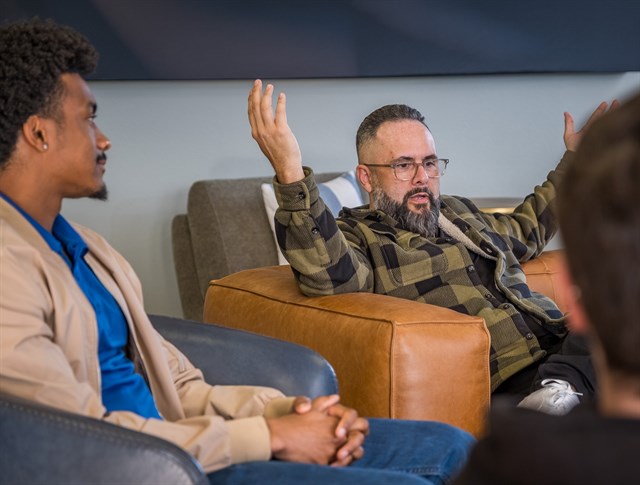












Editor’s Note: This is one of the stories published in the March/April 2026 issue of ETX View Magazine, a product of the Tyler Morning Telegraph and Longview News-Journal. More stories will be posted in the coming days. To read the full digital flipbook, visit etxview.com .
For years and years, parents and grandparents in East Texas church pews have pondered the question and prayed for answers: “Where did our children go?”
Baby Boomers and their parents were the most statistically significant church-goers for years, but when their children and grandchildren grew up and moved out of the house, they didn’t follow their families’ Sunday morning traditions, statistically speaking. The number of Americans who identify as Christians has dropped 15% in the past two decades, from 78% in 2007 to 63% in 2024, according to the Pew Research Center. Church attendance dropped drastically, too.
America’s religious and spiritual decline, especially among younger generations, is nothing new. It’s so profound that Robert F. Kennedy Jr., the nation’s secretary of health, in February said the nation is in a “spiritual malaise” that is contributing to its addiction epidemic.
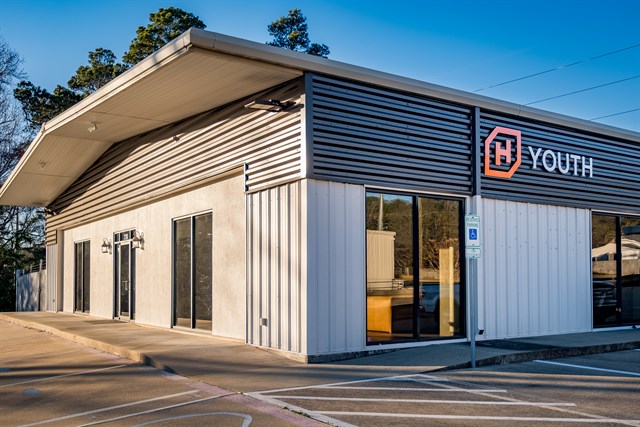
If any group of Americans is going to reverse the trend, it would have to be a generation that is hungry for something different. And Tim Ingram, senior pastor of HighRidge Church in Longview, thinks such a generation is rising up. Young adults aren’t just coming back to church on Sundays; they’re looking for something they can take with them all through the week.
“There’s a hunger for community, hunger for relationships, hunger for authenticity,” he said.
That quest stands in contrast to what he said many young adults express a desire to escape: “Most of the digital world is fake and polished.”
‘They’re plugging in’
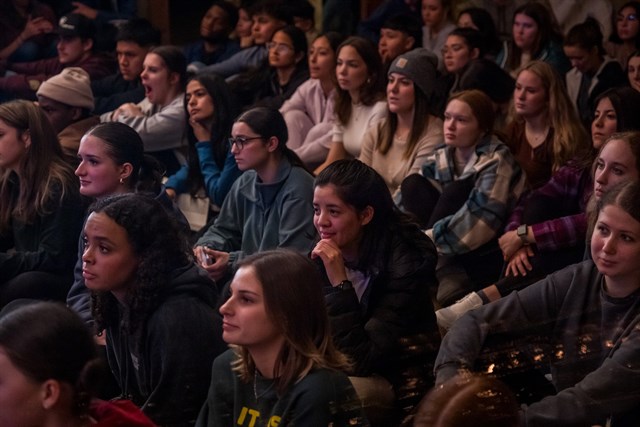
Whether America is undergoing a spiritual revival is up for debate. Data from the Barna Group, a firm that tracks statistics related to religiosity in America, showed in 2025 that Gen Z and Millennial people now are the most regular church-goers in the country. A typical Gen Z churchgoer and a typical Millennial churchgoer attend an average of 1.9 and 1.8 church services per month, respectively. That’s compared to Baby Boomers and elders, who attend an average of 1.4 services per month.
That uptick in youthful attendance began after the coronavirus pandemic, and it seems to have grown in the wake of conservative influencer Charlie Kirk’s assassination in September 2025, Ingram said. In Longview, a number of young men started attending local churches – not just HighRidge – because they believe Kirk took his belief in God seriously, and they were inspired, Ingram said. He went so far as to say those young men were “desperate” to see a similar fire of faith lit within themselves and desperate to be around people who have it.
“It’s been wonderful to see,” Ingram said. “They’re not just coming. They’re staying, and they’re plugging in.”
The search for a deeper connection is one force driving young adults to church. Deep desires for identity and direction are motivating young adults as well.
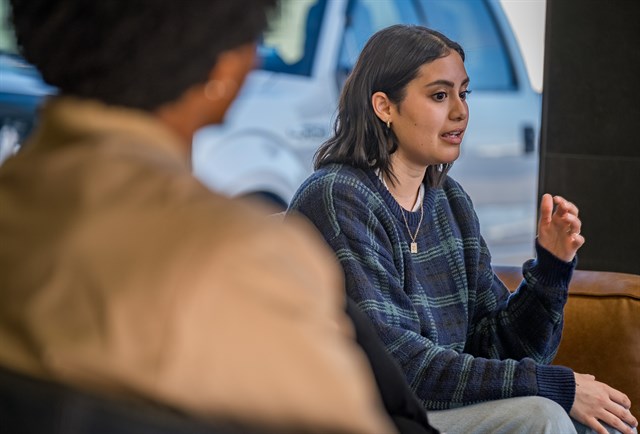
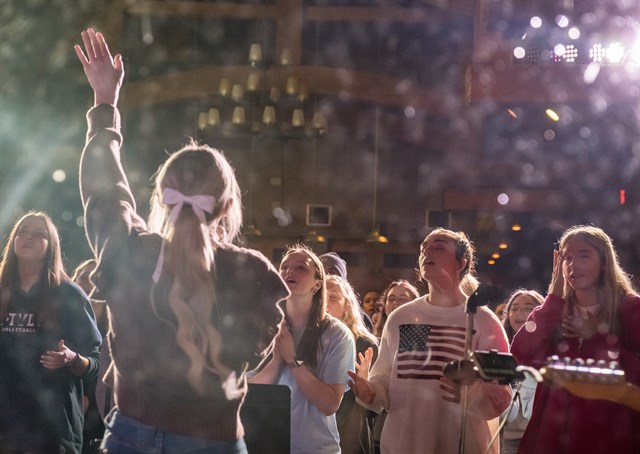
Ingram’s daughter, Natalie McCullen, is newly married at 23 and leads youth worship at the church. She said she believes a relationship with God doesn’t have to be complicated or perfect, but it does provide abundant life – exactly what women her age are looking for when they show up at church.
Commonly, young women are struggling with insecurity about their purpose, worries about their careers, troubles with romantic relationships, body image issues and financial hardship. Those stressors produce the anxiety that some 60% of Gen Zers have reported struggling with, according to the American Psychological Association.
Yet those are all problems God can help people overcome, McCullen said. Her testimony as someone who grew up in a churched home was that she silently struggled with fear and “kept all my emotions bottled up inside,” she said.
“But definitely, throughout my life with Christ, over and over again, He’s pulled that out of me and been like, ‘Come on. I can lead you to a better place. I can lead you to be bold,’” she said.
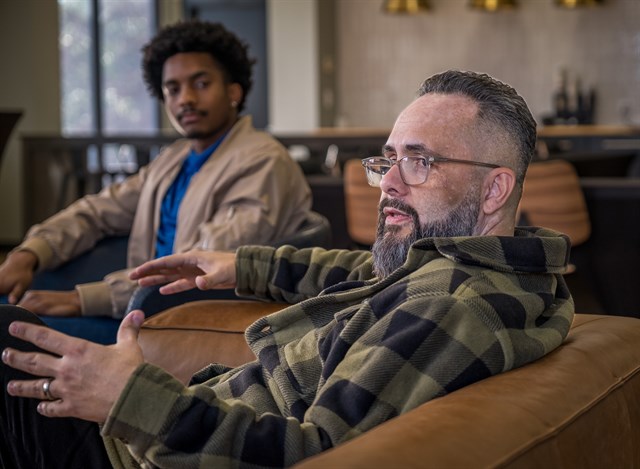
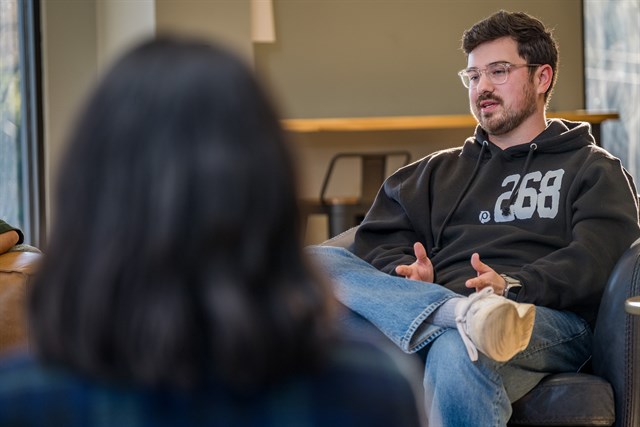
“Doing an interview like this,” she told ETX View one sunny January afternoon at HighRidge, “would have scared me.” She laughed with her dad and peers. “I would have never done this.”
Part of that change comes through grounded, loving relationships with fellow women of faith. Of course, taking the first step to establish a relationship – being vulnerable – can be hard.
“But a healthy church will have healthy women who show you what to do, who can show you the way, who can show you how to walk with Christ as a female,” McCullen said.
Changing the way someone walks, metaphorically speaking, starts in a place of uncomfortable realization. After years of living with the same sins, 25-year-old Christian Hunter knew he believed in God, but he wasn’t living that way. He struggled with lust, greed, pornography, comparison, striving for worldly success.
“I wanted to do what I wanted to do,” he said. “I wanted to be the cool kid on the block.” But after nights of partying and self-indulgence, guilt overwhelmed him. He sank into deep depression, and at one point, he attempted suicide.
Change began with an examination of himself, the things he believes and what the fruits his life were really producing. Then, the hardest part: being open and honest with himself and others. He sought community with others at HighRidge and attended counseling.
“It’s literally like diving in and digging into the mud, the grit, everything that was inside of me,” Hunter said. What surprised him most was the result: “That just allowed me to heal, honestly. It brought peace to my mind, peace to my heart. I just feel so much lighter.”
He used to live his day-to-day life sure he was bound to fail, destined to fall into the same vices over and over. But talking about that stuff with God gave him the power to overcome, he said.
“I cannot put into words, but it’s real, and it’s out there for everyone,” he said. “It’s just asking the Holy Spirit to lead me through the day.”
Church leaders are praying for the same as they lead young adults searching for truth.
‘He loves you’
At Trinity Fellowship Church of Tyler, Pastor David Cook is excited to see people between the ages of 19 and 26 showing up and seeking “an authentic experience with God,” he said.
What they could care less about is the church’s appearance and whether the worship feels like a concert with lights and smoke machines. “That helped the Gen X generation connect to the church,” he said. “But by the time we got to the Millenials, that was already wearing off. And now, the Gen Z generation seems to be looking for, ‘Just give me something real.’”
That’s what Cook and his peers at Trinity are attempting to provide. That begins by meeting people where they are – understanding that people are walking in from every walk of life, so to speak. Chiefly, Cook said church leaders are making room for God to move. If they see people are deeply invested in a moment of worship, they’ll extend it. The sermons preached on Sunday are meant to hit at the heart of the issues facing people today – real issues: relationship trouble, gender and identity confusion, anxiety, poor self-image and a lack of self-confidence.
Another big problem young adults are facing is the urge to compare themselves to others, Cook said. Many people watch influencers on social media and try to attain such prominence for themselves because that’s the only thing they think will make their lives meaningful.
“What we’re trying to show them is that you’re valuable, not for what you can do, but because of who you are. You were made in the image of God,” he said. “He loves you.”
In the past, some sin issues have been treated as too taboo to address in mainline American churches, especially those relating to sexuality and gender identity. But now, churches are more willing to help people face those problems and discover the truth: Freedom is available.
“We’re all broken at some level,” Cook said. “Anyone who is dealing with sin is really dealing with some form of brokenness in their life, and that’s what the church is here to do. The church is here to meet them at their point of need.”
At Mobberly Baptist Church in Longview, Dr. Andrew Hébert, the church’s lead pastor, said the church’s overall attendance has grown since the coronavirus pandemic. Young people are attending regularly, he said. Church attendance has grown from roughly 1,650 to 2,200 weekly in the past three years. He estimates there’s an “almost even split” between those over and under the age of 40.
Young adults commonly struggle with mental health, anxiety issues, sexual immorality and loneliness, Hébert said.
“There is a mix of young adults who were raised in church and those who’ve never been to church before,” he said. “There is a deficit of truth in our culture. Institutional trust is at an all-time low. People don’t know where to look for hope. What I hear most of all is that young people are hungry for truth. The Biblical truth that they find at church, as well as the courage to stand for the truth, is something they find compelling.”
Their pursuit seems sincere, too. Many young adults have been serving in church positions, and last year, a mission trip of more than 400 people was comprised of many young adults, Hébert said.
“There are great reasons for optimism about the next generation,” Hébert said. “They are bold, courageous, hungry for truth, committed and willing to make great sacrifices to serve Jesus.”
‘You’re missing out’
Not everyone’s journey begins in a traditional church, though. Boathouse Ministries in Tyler has become one of the top faith-based organizations for young adults in the area, especially those who move into the region for college. It offers weekly worship, Bible studies and food, all with a goal of helping young adults find Christian community and a church home. Some come there because they were raised up in church and want to carry their youthful faith into adulthood. Others show up because they haven’t interacted much with the God who can change them, but they’d like to start now.
Braden Brady, the ministry’s men’s director, has his focus on building relationships with and discipling other young men, partly through weekly Bible studies with about 30 or 40 guys. Brady is 24, and he said he thinks other men and women his age are tired of drinking what the world has to offer; they’re looking for good water, spiritually speaking. (Ironically, Boathouse has outgrown its namesake location near a lake. What began with a dozen or more guys on a boat has grown to include 700 or so men and women weekly at its height.)
Because Boathouse isn’t a traditional church, people who might not darken the doors of one are more willing to show up there, Brady said. People show up for the food, fun and games, and they “end up finding Christ,” he said. From there, ministry leaders can help them connect with a local church.
Matt Hoffman, 25, started college at UT Tyler in 2019 and joined Boathouse around the same time. He grew up in a Christian home, faithfully attended church and youth groups and wanted to make his faith his own when he went to college.
That said, he sees the struggles and the lies that many his age have believed. “As a young person, a lot of people think that living outside of God’s way of life is the way to really have fun or experience life,” he said. “But I’m pretty confident you can stack my college experience of being involved in ministry next to anyone who said they had a great time in college, and I think I had more fun, more lasting joy.”
Another common lie he can counter personally: “A lot of people get caught up in social media and comparison. … But God offers us true, abundant life in Him. True satisfaction. True joy. True pleasure is found living with Christ and abiding with Him.
“You’re missing out if you don’t.”
Trinity Hawkins, 21, came to Tyler to play softball at Tyler Junior College. Although she was raised in a Christian household, she did what other college students do. “I was conformed to the party culture … and what college defines as fun,” she said.
That mindset has changed, however. A friend invited her to Boathouse, and through a relationship with Jesus, her desires changed.
“I truly don’t really desire to go out and party or drink or seek my worth in any of those things because I know that was ultimately me trying to fill a void in happiness that ultimately is temporary,” she said.
“I was kind of just here and living and didn’t really have a true hope. I can live for so much joy and for a higher purpose, ultimately to extend the love and ministry of Jesus Christ and to serve.”
Rather than rooting her identity in social media, societal standards or any other part of this corrupted world, she said she’s found true identity in Christ and wants other young people to find that, too.
“I believe many young adults are realizing that the world cannot satisfy the deeper longing in our hearts,” she said. “Only Jesus can fill that void.”
Back at HighRidge in Longview, Ingram, the senior pastor, wants more young people to find those same convictions.
“We’re trying to be very careful to make sure we don’t hurt them in any way, but give them what they’re needing: a relationship with the Lord, a good biblical foundation, good community with people that will invest in them and treat them as more than just kids,” he said. “It’s cause for great hope.”