Three’s A Charm: Alan Henry angler catches ShareLunker for third time
Published 7:32 pm Friday, February 13, 2026
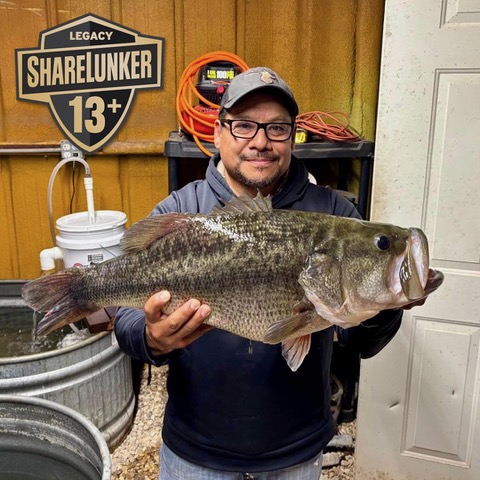
For a crappie fisherman, Ross Gomez of Post is a pretty good bass fisherman. Who would not want his three best totaling 42.74 pounds?
That’s an average of 14.25-pound per fish, indicating Gomez has had an entry in the Texas Parks and Wildlife Department’s ShareLunker program. The truth is he has now had three entries, No. 641 in 2023, 674 in 2025 and as of Jan. 22 when he landed a 14.74-pounder on Lake Alan Henry, No. 685. Except he really does not have three. He has one. The 13.22-pound No. 641, 14.78-pound No. 674 and this year’s catch have all been the same fish according to an electronic identification tag placed in the fish the first time it was taken to the Texas Freshwater Fisheries Center in Athens.
Even more interesting is that Gomez caught it each time while fishing off the same pier. The first two times he was crappie fishing when he caught the bass. This time, probably to the relief of bass fishermen throughout the state, he was fishing for bass with a jerk bait.
Gomez’ bass is actually the second to be caught three times. Another was caught annually between from 2005 to 2007 also on Alan Henry, but by three different fishermen. During that same run that fish’s half-sister was also caught.
In the history of the ShareLunker program, which started in 1986, 10 bass have been caught more than once. Also, 26 fishermen have entered more than one 13-pound-plus bass into the program.
While at the TFFC, Gomez’ bass has been a productive sow. In 2023 she produced an estimated 32,285 fry and in 2025 she produced 72,133. What she does this spring will be dependent on her age and health, however, DNA testing after she was previously caught showed the fish was a Florida bass/native northern bass cross meaning she was not hatchery produced so her age is unknown.
Based on TPWD’S two-year bass telemetry study on Lake Fork and Toledo Bend, Gomez’ catch was not a major surprise.
“Truthfully, it doesn’t surprise me at all,” said Jake Norman, TPWD Fisheries district biologist and a principal in the study. “I was likely in the minority of not very surprised people when the Alan Henry fish was caught by the same angler in the same spot for the third time.”
Norman said the study confirmed what some fishermen have always believed, and that is that some bass have a home range they stay in most or all their life.
“Our telemetry results took this even further and demonstrated some bass keep their small range 365 days a year. The results also demonstrated that a bass with tens of thousands of acres can and will survive within 100-150 acres of the same water year-round, barring any drastic environmental changes such as severe drought or severe cold,” Norman said.
He added some bass for some reason feel comfortable in an area, and will continue to return to that area after being caught no matter where they are released. Gomez’ fish was initially released about three miles from where it was caught, and about two miles away last year.
While most bass have a home range, Norman said some narrowed it down even more.
“We located multiple fish over the course of two to three straight months on the same stump or tree. Not several fish using the exact stump, but rather that several fish had their stump or tree. Not only were several bass staying within the same cove, pocket, point, etc., but they were on the exact same piece of standing timber when we found them for several months in a row. These fish were likely mimicking the ‘groove in the recliner’ type of people. They have a routine they are comfortable with, and very few things will alter that,” Norman said.
Most of the bass with a home range tended to stay there throughout the year, with slight moves toward shore to spawn in the spring, and sometimes changing to other structures during the various seasons.
Norman said there is not a definitive answer on why some bass hold to an area year-round, but in contrast there were plenty others constantly moving.
“They were in a different place every time we found them. I recall one bass we only located a few times the entire study because it was rarely within the several-mile study zone. In fact, the last time we found this fish it was a mile north outside of Birch Creek (on Fork) in a patch of pondweed next to a boat dock. Do you know how many patches of pondweed by boat docks this fish swam by from its previous location, to get here? It simply doesn’t make sense,” Norman said.
It may all come down to it is a southern thing.
“I’ll just reiterate that some of the wild things we see fish do, will never be explained. A lot of bass, at least in southern reservoirs, keep things simple. They find an area of the lake that they are comfortable with and stay there. Bass are typically one of the top predators in their waterbodies. If they have a place to rest, a place to eat, and a place to reproduce, they don’t need to move,” Norman said.
—Contact Steve Knight at outdoor@tylerpaper.com